PRODUCT SHEET

Combined Didymium/Neutral Density Glass

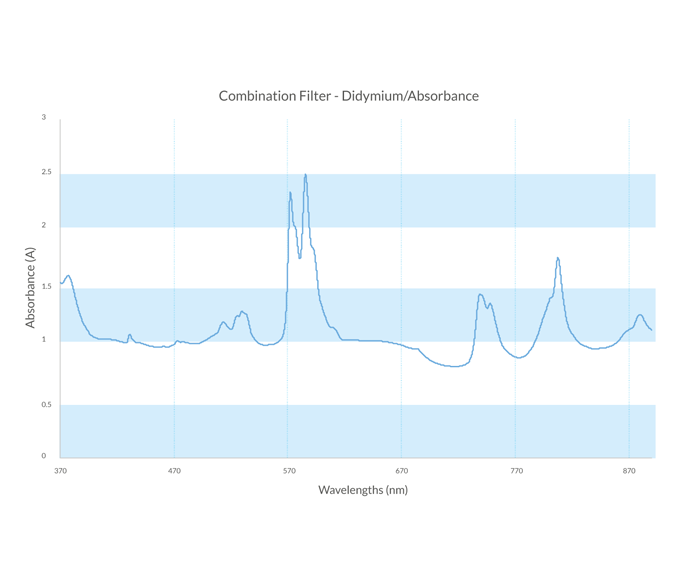
This filter is a useful tool for routinely checking the wavelength and absorbance accuracy of a visible spectrophotometer. Like its liquid counterpart, the didymium glass filter produces characteristic peaks that make it suitable for use as a wavelength reference material in the visible region of the spectrum. In this filter, the didymium is optically bonded to a neutral density filter giving a nominal 1A background absorbance that can be used to check the absorbance accuracy of the instrument

Features and Purposes

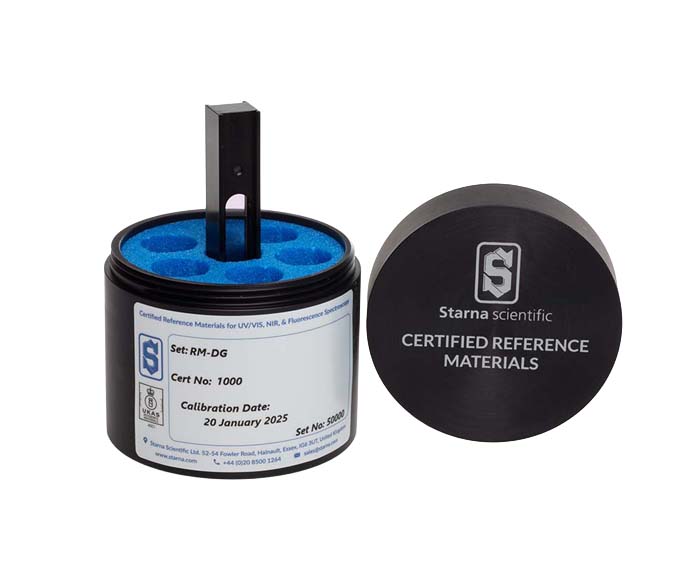
Glass filter containing didymium (a mixture of neodymium & praseodymium) oxide, optically bonded to a neutral density filter and mounted stress free in an anodised aluminium holder. Sliding window covers are provided to protect the surface from damage when not in use. Variations from melt to melt of the glass can cause small uncertainties in peak position, so each Starna filter is individually certified.

9 characteristic and well-defined peaks can be certified, covering the wavelength range from 430 nm to 890 nm. This spectrum is superimposed on a constant background absorbance, nominally 1A.


DOCUMENTS AND RESOURCES
Starna Cell Catalogue Original
PRODUCT SHEET

Combined Didymium/Neutral Density Glass

This filter is a useful tool for routinely checking the wavelength and absorbance accuracy of a visible spectrophotometer. Like its liquid counterpart, the didymium glass filter produces characteristic peaks that make it suitable for use as a wavelength reference material in the visible region of the spectrum. In this filter, the didymium is optically bonded to a neutral density filter giving a nominal 1A background absorbance that can be used to check the absorbance accuracy of the instrument

Features and Purposes

Glass filter containing didymium (a mixture of neodymium & praseodymium) oxide, optically bonded to a neutral density filter and mounted stress free in an anodised aluminium holder. Sliding window covers are provided to protect the surface from damage when not in use. Variations from melt to melt of the glass can cause small uncertainties in peak position, so each Starna filter is individually certified.

9 characteristic and well-defined peaks can be certified, covering the wavelength range from 430 nm to 890 nm. This spectrum is superimposed on a constant background absorbance, nominally 1A.
DOCUMENTS AND RESOURCES
Starna Cell Catalogue Original

Contact us to discover the offer dedicated to this product!

Compila il form per richiedere un preventivo.

Compila il form per richiedere un preventivo.