Starna Green Microvolume References are specially developed reference materials for qualification of low volume (< 5 µL) and short path length (< 1 mm) spectrophotometric instruments. These references cater to users requiring precise validation when sample volume is limited and are suitable also for conventional spectrophotometers used with ultra-low-volume cells such as Starna DMV cells. The material is fully REACH compliant due to its physical transfer into the measurement device by the operator.
Many microvolume spectrophotometers operate with relatively wide spectral bandwidths, up to 8 nm. Conventional references, designed for instruments with bandwidths ≤ 3 nm, often contain sharp absorption bands that may not be suitable for these analyzers. Starna Green uses an aqueous dye solution with three broad, well-defined absorption peaks certified for wavelength and absorbance values in the UV and visible regions, supporting bandwidths up to 20 nm. This enables reliable validation of wavelength, absorbance scale, and linearity for instruments with wider bandwidths.
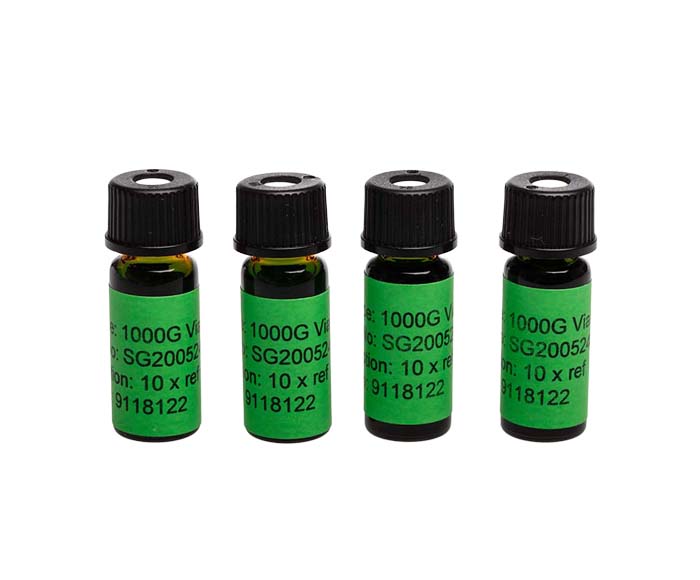
Starna Green Microvolume References are specially developed reference materials for qualification of low volume (< 5 µL) and short path length (< 1 mm) spectrophotometric instruments. These references cater to users requiring precise validation when sample volume is limited and are suitable also for conventional spectrophotometers used with ultra-low-volume cells such as Starna DMV cells. The material is fully REACH compliant due to its physical transfer into the measurement device by the operator.
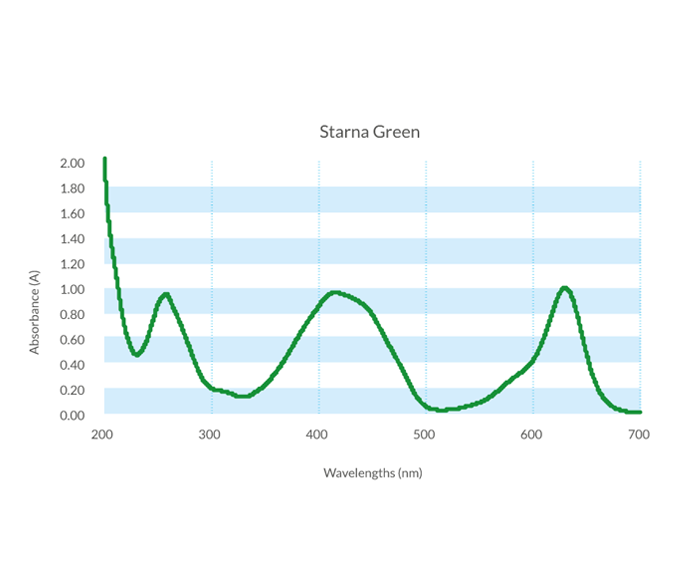
Many microvolume spectrophotometers operate with relatively wide spectral bandwidths, up to 8 nm. Conventional references, designed for instruments with bandwidths ≤ 3 nm, often contain sharp absorption bands that may not be suitable for these analyzers. Starna Green uses an aqueous dye solution with three broad, well-defined absorption peaks certified for wavelength and absorbance values in the UV and visible regions, supporting bandwidths up to 20 nm. This enables reliable validation of wavelength, absorbance scale, and linearity for instruments with wider bandwidths.

