PRODUCT SHEET

Metal-on-Quartz Neutral Density Filters (250 – 3200 nm)

This Reference Material is designed to qualify the Absorbance scale of spectrophotometers operating in the ultraviolet, visible, and near-infrared spectral regions from 250 nm to 3200 nm. It is suitable for instruments with spectral bandwidths not exceeding 6.5 nm, with certification values measured at 1 nm bandwidth.

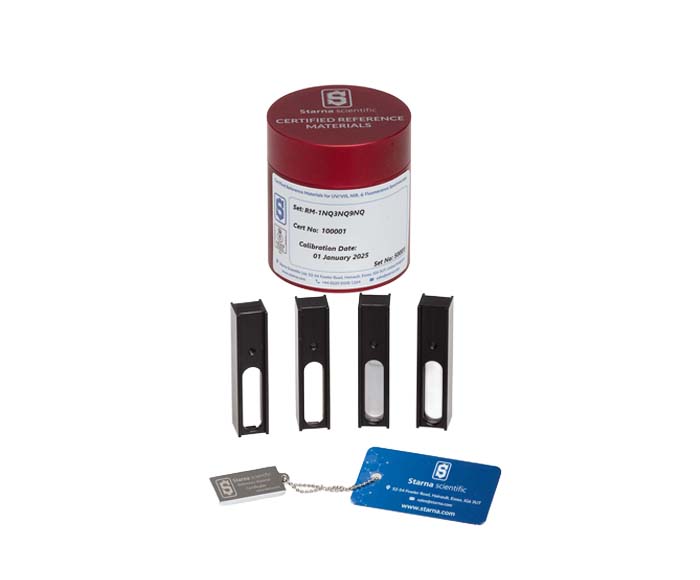
The filters consist of a quartz plate coated with a metallic layer whose thickness determines the transmission characteristics. This metallic surface is protected by an optically bonded cover plate, offering enhanced durability against oxidation, contamination, and physical damage compared to typical overcoating methods. Filters are housed in stress-free, black-anodized aluminium alloy holders equipped with front and rear sliding covers for protection when not in use. Each filter or set is supplied with an empty holder as a measurement reference.
Features and Purposes
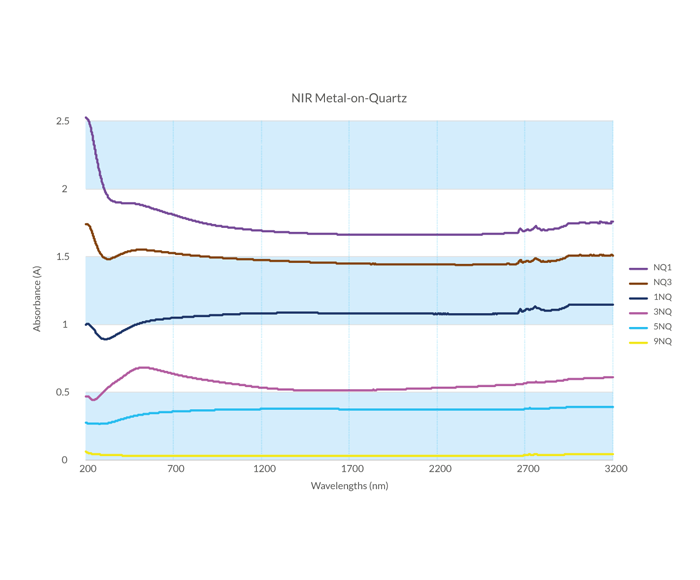
  • Flat spectral response from 250 nm to 3200 nm with certified Absorbance and Transmittance values at key wavelengths: 250.0, 360.0, 465.0, 546.1, 635, 1100, 1700, 2210, 2500, and 2800 nm.
  • Transmission values based on a NIST SRM series, available in approximate transmittance: 92 %T (0.04 A), 50 %T (0.3 A), 30 %T (0.5 A), 10 %T (1.0 A), 3 %T (1.5 A), and 1 %T (2.0 A).
  • Filters are mounted in stress-free, black-anodized aluminium holders with protective sliding covers.
  • Available as individual filters or in sets combining multiple transmittance levels with a blank holder for reference measurements.
  • Note: Due to partial attenuation by reflection, inter-reflections may occur inside certain spectrophotometer sample compartments; users should verify instrument compatibility before use.
DOCUMENTS AND RESOURCES
Certified Reference Materials for Spectroscopy
Starna Cell Catalogue - Micro Rectangular Spectroscopy Cells
Metal on Quartz Neutral Density Filters for Spectrophotometer Absorbance Qualification 250 to 3200 nm
PRODUCT SHEET

Metal-on-Quartz Neutral Density Filters (250 – 3200 nm)

This Reference Material is designed to qualify the Absorbance scale of spectrophotometers operating in the ultraviolet, visible, and near-infrared spectral regions from 250 nm to 3200 nm. It is suitable for instruments with spectral bandwidths not exceeding 6.5 nm, with certification values measured at 1 nm bandwidth.

The filters consist of a quartz plate coated with a metallic layer whose thickness determines the transmission characteristics. This metallic surface is protected by an optically bonded cover plate, offering enhanced durability against oxidation, contamination, and physical damage compared to typical overcoating methods. Filters are housed in stress-free, black-anodized aluminium alloy holders equipped with front and rear sliding covers for protection when not in use. Each filter or set is supplied with an empty holder as a measurement reference.


Features and Purposes
  • Flat spectral response from 250 nm to 3200 nm with certified Absorbance and Transmittance values at key wavelengths: 250.0, 360.0, 465.0, 546.1, 635, 1100, 1700, 2210, 2500, and 2800 nm.
  • Transmission values based on a NIST SRM series, available in approximate transmittance: 92 %T (0.04 A), 50 %T (0.3 A), 30 %T (0.5 A), 10 %T (1.0 A), 3 %T (1.5 A), and 1 %T (2.0 A).
  • Filters are mounted in stress-free, black-anodized aluminium holders with protective sliding covers.
  • Available as individual filters or in sets combining multiple transmittance levels with a blank holder for reference measurements.
  • Note: Due to partial attenuation by reflection, inter-reflections may occur inside certain spectrophotometer sample compartments; users should verify instrument compatibility before use.
DOCUMENTS AND RESOURCES
Certified Reference Materials for Spectroscopy
Starna Cell Catalogue - Micro Rectangular Spectroscopy Cells
Metal on Quartz Neutral Density Filters for Spectrophotometer Absorbance Qualification 250 to 3200 nm

Contact us to discover the offer dedicated to this product!

Compila il form per richiedere un preventivo.

Compila il form per richiedere un preventivo.